Scripture Scents
Balm of Gilead
Hebrew tsori
Genesis 37:25 · Jeremiah 8:22
“Is there no balm in Gilead?” Jeremiah’s cry has outlived the plant itself. The balm of Gilead was a famous healing resin of the ancient world, and no one is certain today exactly what it was.
In Scripture
Is there no balm in Gilead? Is there no physician there? Why then has the health of the daughter of my people not been restored?
Jeremiah 8:22 (ESV)
Then they sat down to eat. And looking up they saw a caravan of Ishmaelites coming from Gilead, with their camels bearing gum, balm, and myrrh, on their way to carry it down to Egypt.
Genesis 37:25 (ESV)
Then their father Israel said to them, “If it must be so, then do this: take some of the choice fruits of the land in your bags, and carry a present down to the man, a little balm and a little honey, gum, myrrh, pistachio nuts, and almonds.
Genesis 43:11 (ESV)
Balm (Hebrew tsori) rides in the Ishmaelite caravan that carried Joseph to Egypt, and Jacob sends “a little balm” as a gift to Egypt’s ruler. Gilead, east of the Jordan, was known for it. Jeremiah uses the healing resin to lament a wound the people would not let God heal: “Is there no balm in Gilead? Is there no physician there?” Christians later answered his question in the spiritual “There is a balm in Gilead.” Jeremiah returns to the image twice more, telling Egypt to go up to Gilead for balm in vain (46:11) and telling the nations to bring balm for fallen Babylon’s pain (51:8). Ezekiel lists balm among the goods Judah sold in the markets of Tyre (27:17). Across the Old Testament it is the medicine of last resort, valuable enough to trade and to give to a ruler, and yet unable to heal a people who refuse their physician.
What it is today
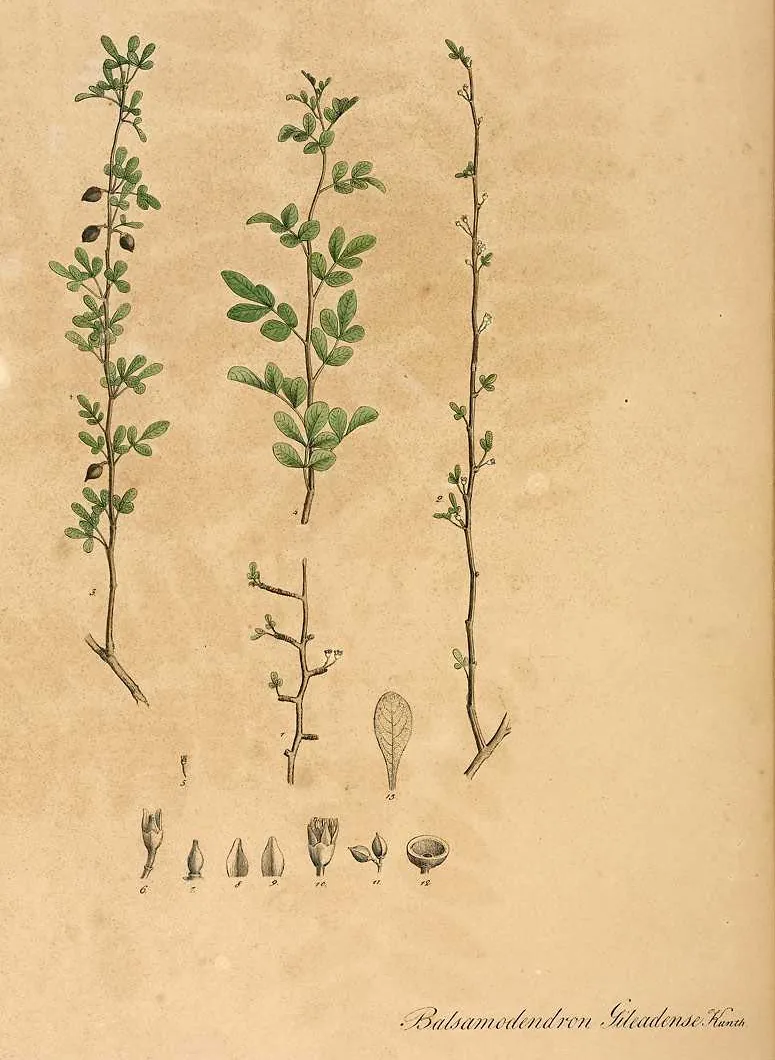
The most likely candidate is Commiphora gileadensis, a relative of myrrh sometimes called opobalsamum or balsam of Mecca. Ancient writers including Josephus and Pliny describe a precious balsam grown in royal plantations near Jericho and Engedi. The mosaic floor of the ancient synagogue at Engedi carries a curse on anyone who reveals “the secret of the town,” which many scholars take to mean the method of growing and processing balsam. That cultivation died out, and the identification is debated. In recent years a few growers near the Dead Sea have begun replanting the shrub. What stores sell today as “balm of Gilead” is usually an absolute from the resinous buds of balsam poplar (Populus), a different plant entirely, long used in North American folk salves.
In the bottle
Poplar-bud absolute smells warm, honeyed and balsamic, with a resinous, almost propolis-like sweetness. It works as a soft base in amber and incense blends, where it rounds off the edges of frankincense and gives labdanum a lighter, golden tone. The Atlas has no profile for it yet. If you try it, start at a low dilution and build up slowly, because its sweetness can quickly cover everything else. Treat it as a resinoid and follow your supplier’s safety guidance.