Scripture Scents
Henna (camphire)
Hebrew kopher
Song of Songs 1:14 · 4:13
Most people know henna as a dye. In the Song of Songs it is a flower, and the beloved is like “a cluster of henna blossoms in the vineyards of Engedi.”
In Scripture
My beloved is to me a cluster of henna blossoms in the vineyards of Engedi.
Song of Songs 1:14 (ESV)
Your shoots are an orchard of pomegranates with all choicest fruits, henna with nard, nard and saffron, calamus and cinnamon, with all trees of frankincense, myrrh and aloes, with all choice spices …
Song of Songs 4:13–14 (ESV)
The Hebrew kopher appears in Song of Songs 1:14 and 4:13. Older English Bibles render it “camphire.” Engedi, an oasis of springs beside the Dead Sea, was famous for its gardens and aromatic plants, so the image is of something rare and sweet blooming in a desert. Henna’s blossoms hang in fragrant clusters, a natural picture of a lover held close. In 4:13 henna stands at the head of a whole garden of spices, “henna with nard,” followed by saffron, calamus, cinnamon, frankincense, myrrh and aloes. The word itself carries an echo. Kopher, henna, is spelled the same as kopher, ransom or covering, from the root behind kippur, atonement. The Song never draws the connection, but readers have long noticed it.
What it is today
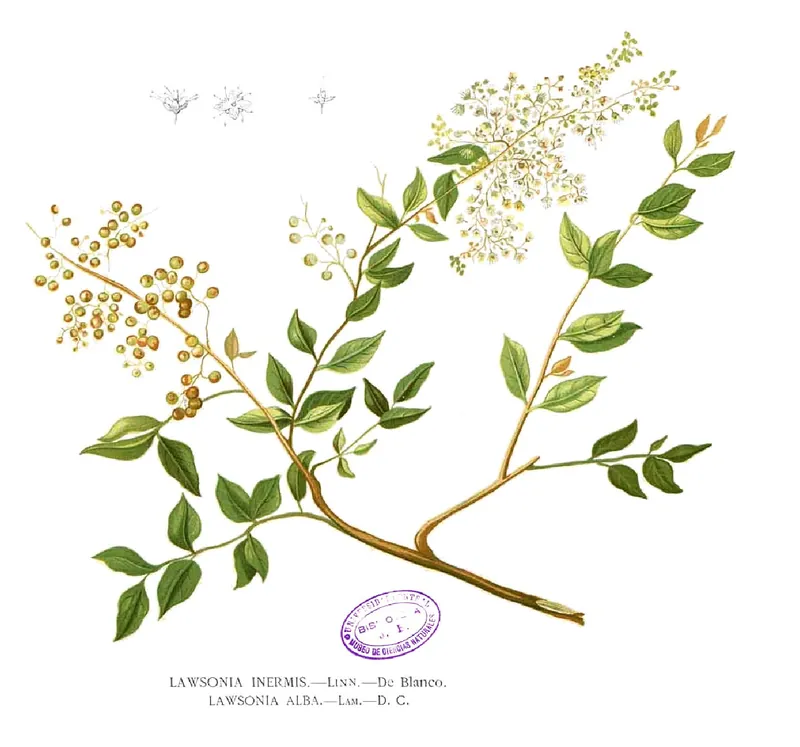
Henna is Lawsonia inermis, a shrub of North Africa, the Middle East and South Asia. Its leaves give the familiar red-orange dye, while its small white to pink flowers are richly scented. Greek and Roman writers knew the plant as kypros, and an oil scented with its flowers was made in Egypt and prized across the Mediterranean. Henna flower absolute (sometimes called mehndi) is made in small quantities in India and is rare in Western perfumery. The traditional Indian attar called hina is a different thing: a complex blend of herbs and spices distilled into sandalwood oil, named for henna rather than made only from it.
In the bottle
Henna blossom smells sweet, honeyed and slightly spicy, somewhere between mignonette, rose and tea. The Atlas has no henna profile because the absolute is so hard to find. To suggest it, perfumers lean on rose, a touch of saffron and a soft hay note such as coumarin. If you do find a sample, smell it on a strip over a full day. Its character shifts from bright and floral at first to warm and tea-like as it dries, and that slow change is the best guide to how much of it a blend can carry.