Scripture Scents
Myrrh
Hebrew mor · Greek smyrna
Exodus 30:23 · Psalm 45:8 · Matthew 2:11 · John 19:39
Myrrh is the bitter one. Its name comes from the Semitic root for bitterness, and it follows the life of Jesus from the magi’s gift at his birth to the spices brought for his burial. It was also the first and largest ingredient of the holy anointing oil.
In Scripture
your robes are all fragrant with myrrh and aloes and cassia. From ivory palaces stringed instruments make you glad …
Psalm 45:8 (ESV)
Nicodemus also, who earlier had come to Jesus by night, came bringing a mixture of myrrh and aloes, about seventy-five pounds in weight.
John 19:39 (ESV)
Take the finest spices: of liquid myrrh 500 shekels, and of sweet-smelling cinnamon half as much, that is, 250, and 250 of aromatic cane, and 500 of cassia, according to the shekel of the sanctuary, and a hin of olive oil. And you shall make of these a sacred anointing oil blended as by the perfumer; it shall be a holy anointing oil.
Exodus 30:23–25 (ESV)
Exodus 30 calls for “liquid myrrh,” 500 shekels of it, more than any other spice in the anointing oil. Myrrh is a perfume of love and royalty in Psalm 45, where the king’s robes are “fragrant with myrrh and aloes and cassia,” and in the Song of Songs. Esther was prepared for the king with “six months with oil of myrrh” (Esther 2:12). In the Gospels it is offered at the cross mixed with wine (Mark 15:23), and Nicodemus brings “a mixture of myrrh and aloes, about seventy-five pounds in weight,” enough for a royal burial.
What it is today
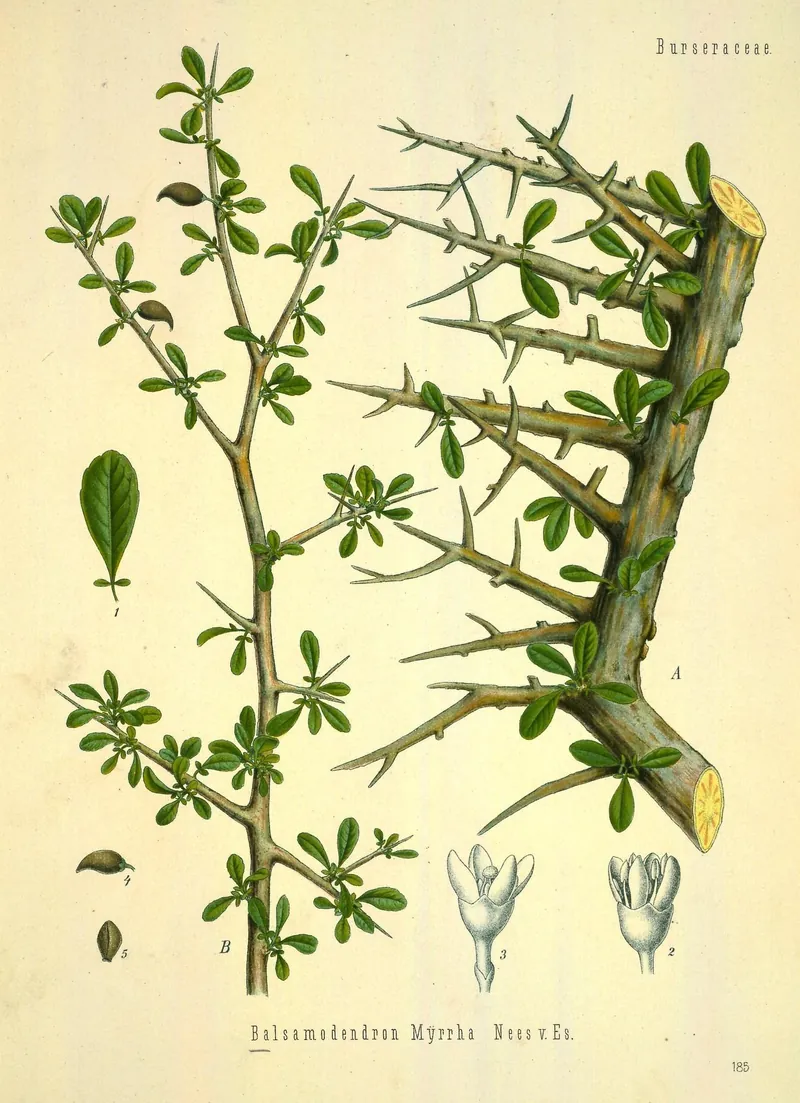
Myrrh is the resin of Commiphora myrrha, a thorny shrub of Somalia, Ethiopia, Yemen and Oman. Like frankincense it is tapped from the bark and dries into reddish-brown lumps. Perfumers use the essential oil, a CO₂ extract or a dark resinoid. What Exodus meant by “liquid” myrrh is debated: perhaps resin that flowed freely on its own, perhaps myrrh already dissolved in oil.
In the bottle
Commiphora myrrha
Bitter, warm-balsamic and a little mushroomy-sweet. Deep and ancient.
First sniff: Bitter, medicinal, warm balsamic with an earthy mushroom note. Once it settles: Deep, dark, sweet-bitter resin that lingers for hours. Reminds people of: Ancient incense, mushrooms, bitter licorice.
Myrrh opens bitter and medicinal, with an earthy, almost mushroom-like note. Hours later it is still there, dark, sweet-bitter and balsamic. It is a base note that gives depth and gravity, and it pairs naturally with frankincense, labdanum and rose. Use it with restraint, because too much turns a blend dusty and sharp.
Blends well with
Frankincense, Benzoin, Rose, Sandalwood, Labdanum, Spikenard, Oud, Cardamom.
Study formulas in the Atlas
Nard & Myrrh (Intermediate): Inspired by the pound of pure nard in John 12:3. Earthy spikenard and bitter myrrh softened by sandalwood, rose and benzoin. Open it in the Scent Atlas.
Cedar & Frankincense (Beginner): Frankincense and cedar (Scripture’s timber of the temple), myrtle for green freshness, myrrh, benzoin and labdanum for the warm, prayerful base. It draws on Scripture’s materials without copying the Exodus 30 incense. Open it in the Scent Atlas.