Scripture Scents
Aloes
Hebrew ahalim / ahaloth
Psalm 45:8 · Proverbs 7:17 · Song of Songs 4:14 · John 19:39
The aloes of Scripture are not the succulent in your kitchen window. In the Old Testament they are almost certainly a fragrant wood, and many scholars identify it as agarwood, the source of oud.
In Scripture
your robes are all fragrant with myrrh and aloes and cassia. From ivory palaces stringed instruments make you glad …
Psalm 45:8 (ESV)
Nicodemus also, who earlier had come to Jesus by night, came bringing a mixture of myrrh and aloes, about seventy-five pounds in weight.
John 19:39 (ESV)
Your shoots are an orchard of pomegranates with all choicest fruits, henna with nard, nard and saffron, calamus and cinnamon, with all trees of frankincense, myrrh and aloes, with all choice spices …
Song of Songs 4:13–14 (ESV)
Aloes (Hebrew ahalim) perfume the king’s robes in Psalm 45:8, scent the bed in Proverbs 7:17, and grow among the choice spices of Song of Songs 4:14. Balaam blesses Israel’s tents as “like aloes that the Lord has planted” (Numbers 24:6). In John 19:39 Nicodemus brings a mixture of myrrh and aloes for Jesus’ burial. Here the identification is debated: some think it was agarwood again, others the bitter juice of the Aloe plant, which was used in embalming.
What it is today
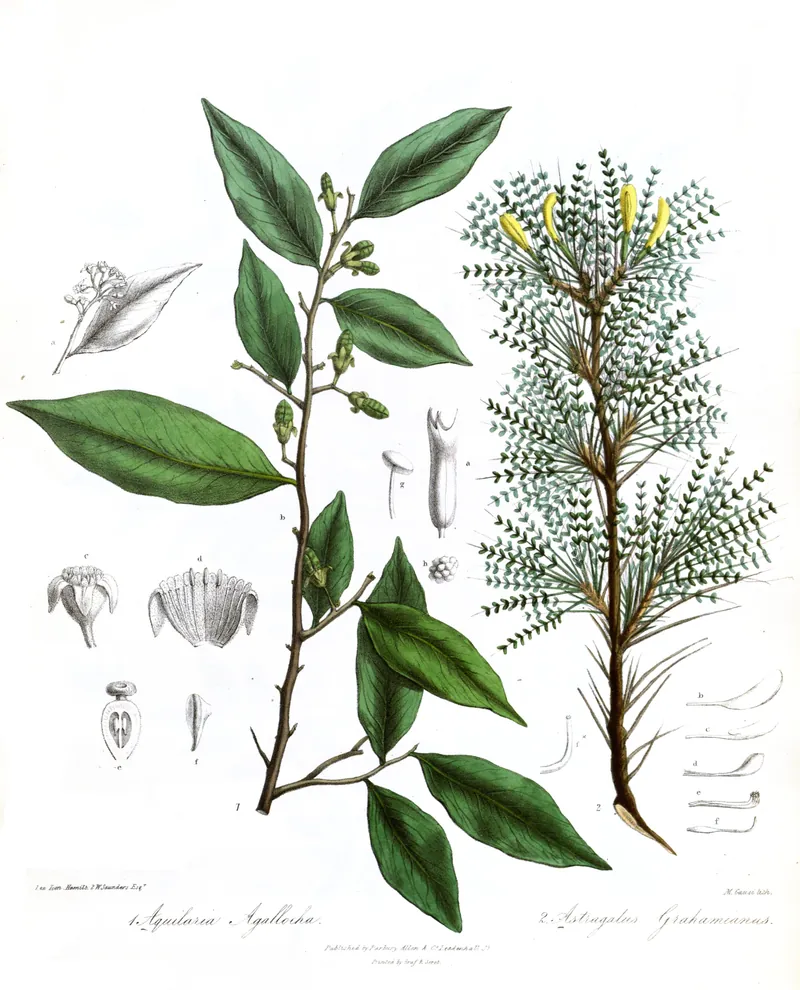
Agarwood forms when trees of the genus Aquilaria, native to South and Southeast Asia, are infected and produce a dark, resin-soaked heartwood in defense. It is among the most expensive natural materials in the world. Wild Aquilaria is endangered and protected under CITES, so ethical perfumers use oud from cultivated, inoculated trees, or oud bases built from aroma chemicals.
In the bottle
Agarwood oil or oud base
Animalic, smoky, leathery, medicinal wood. Dense and dramatic — often identified with the “aloes” of old texts.
First sniff: Dense, animalic, medicinal-smoky wood — it can smell barnyard-like at first. Once it settles: Rich, sweet, leathery-woody depth that lasts for days. Reminds people of: Aged wood, leather, smoky incense.
Oud is deep, woody and smoky, with leathery, medicinal and even barnyard facets that change from one origin to the next. It is a base note of huge presence and lasts for many hours. It sits naturally beside rose, frankincense, sandalwood and saffron. In study blends an oud base is the affordable, sustainable way to learn its shape.
Blends well with
Rose, Saffron, Sandalwood, Frankincense, Patchouli, Labdanum, Cypriol, Guaiacwood, Myrrh.